Extracted images: Impacts of Development on Runoff
Printed revision: September 2016.
Back to source | Original PDF | Image metadata
Original Mistral crops are preserved byte for byte. A crop can be a figure, table, equation, or other visual; no visual content is inferred as a numerical rule. Record and table associations use the same PDF page unless a direct image placeholder is identified. Nearby OCR excerpts are context, not verified captions.
PDF page 1, image 1
Mistral ID: img-0.jpeg. Extraction bundle(s): 2023_BMP_1_Impacts_of_Development_on_Runoff. Original page | Image file
Surrounding OCR excerpt:
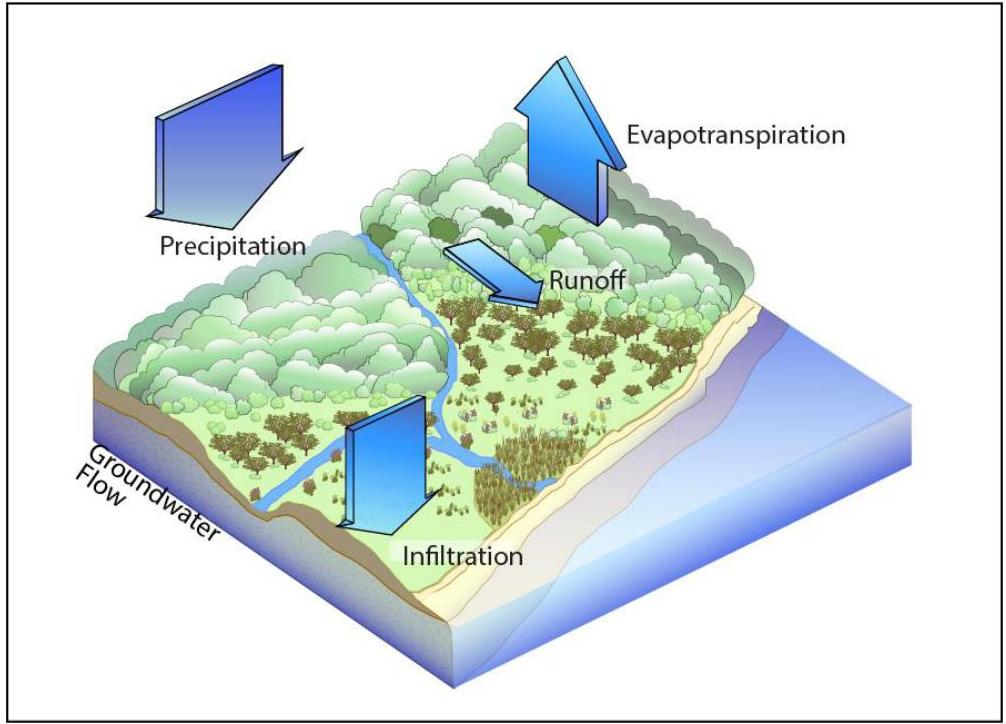
these factors through land development affects the hydrologic response of an area to rainfall, and when these changes occur over large areas, the hydrology of entire watersheds may be significantly altered.

[OCR image]

Water from oceans, rivers, lakes, and soils evaporates and then condenses in the atmosphere to form clouds; the water then returns to the surface through precipitation. Under natural conditions, vegetation intercepts some of the precipitation, which then evaporates back into the atmosphere after the storm.
PDF page 2, image 1
Mistral ID: img-1.jpeg. Extraction bundle(s): 2023_BMP_1_Impacts_of_Development_on_Runoff. Original page | Image file
Surrounding OCR excerpt:
, infiltrate into the groundwater table where it will be stored or provide baseflow to streams, or be taken up by vegetation where it will return to the atmosphere as water vapor through evapotranspiration.

[OCR image]
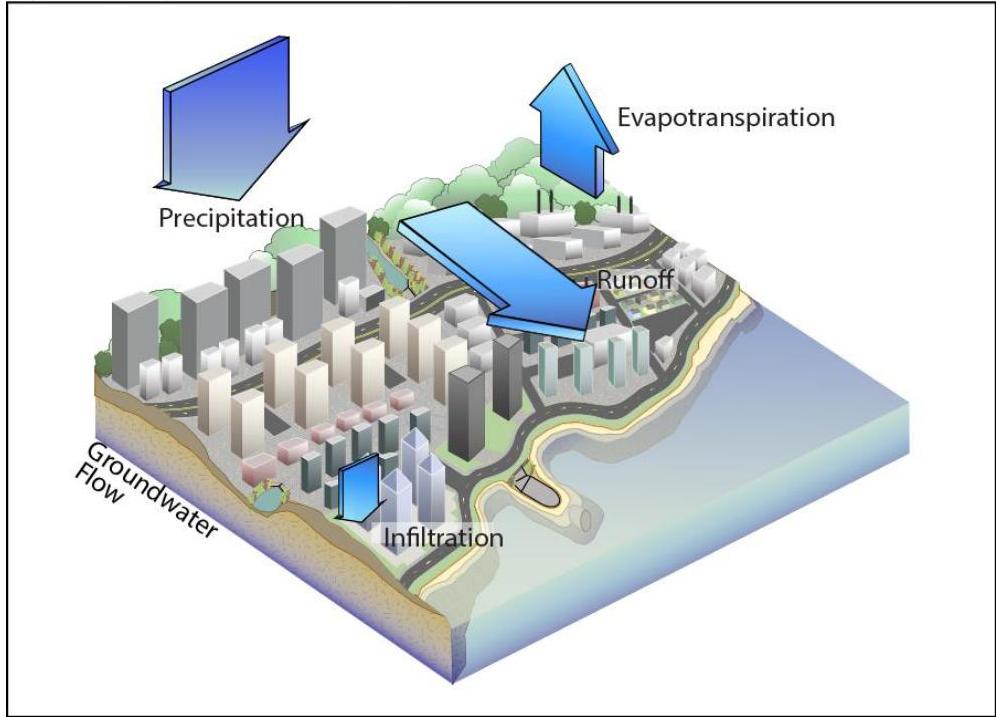
Hydrologic Cycle – Post-development

Land development usually alters this process in many ways, which, if not managed properly, can lead to dramatic changes in the way water moves through the environment. The removal of vegetation from the site has a significant impact on both the interception of precipitation and evapotranspiration, which results in more precipitation reaching the ground surface, and t