Extracted images: Sand Filters (Large-Scale GI)
Printed revision: March 2021.
Back to source | Original PDF | Image metadata
Original Mistral crops are preserved byte for byte. A crop can be a figure, table, equation, or other visual; no visual content is inferred as a numerical rule. Record and table associations use the same PDF page unless a direct image placeholder is identified. Nearby OCR excerpts are context, not verified captions.
PDF page 1, image 1
Mistral ID: img-0.jpeg. Extraction bundle(s): 2023_BMP_10_3_Sand_Filters. Original page | Image file
Tables on the same PDF page: Table 1
Surrounding OCR excerpt:
# 10.3 SAND FILTERS (LARGE-SCALE GI)

[OCR image]

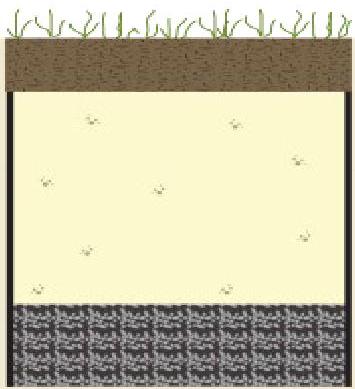
A sand filter designed to infiltrate into the subsoil is a stormwater management system designed to both maximize the removal of pollutants from stormwater and to promote groundwater recharge as well as address the quantity impacts of land development. It consists of a pre-treatment zone and a treatment zone, which includes the sand bed and its underlying materials. Pollutants are treated through settl
PDF page 3, image 1
Mistral ID: img-1.jpeg. Extraction bundle(s): 2023_BMP_10_3_Sand_Filters. Original page | Image file

Surrounding OCR excerpt:
# Applications

[OCR image]

Pursuant to N.J.A.C. 7:8-5.2(a)(2), the minimum design and performance standards for groundwater recharge, stormwater runoff quality and stormwater runoff quantity at N.J.A.C. 7:8- 5.4, 5.5 and 5.6 shall be met by incorporating green infrastructure in accordance with N.J.A.C. 7:8-5.3. Pursuant to N.J.A.C. 7:8-5.3(c), large-scale green infrastructure BMPs - i.e., those that exceed the contributory drain
PDF page 3, image 2
Mistral ID: img-2.jpeg. Extraction bundle(s): 2023_BMP_10_3_Sand_Filters. Original page | Image file

Surrounding OCR excerpt:
8-5.3(c), large-scale green infrastructure BMPs - i.e., those that exceed the contributory drainage area limits at N.J.A.C. 7:8-5.3(b) - may only be used to satisfy the stormwater runoff quantity standards.

[OCR image]

Sand filters designed to infiltrate into the subsoil may be designed to convey storm events larger than the Water Quality Design Storm (WQDS); however, regardless of the design storm chosen, all sand filters designed to infiltrate into the subsoil must be designed for stability and capacity in accordance with the Standards for Soil Erosion and Sediment Control in New Jersey.

[OCR image]
PDF page 3, image 3
Mistral ID: img-3.jpeg. Extraction bundle(s): 2023_BMP_10_3_Sand_Filters. Original page | Image file

Surrounding OCR excerpt:
esign storm chosen, all sand filters designed to infiltrate into the subsoil must be designed for stability and capacity in accordance with the Standards for Soil Erosion and Sediment Control in New Jersey.

[OCR image]

Only if a waiver or variance from the green infrastructure requirements of N.J.A.C. 7:8-5.3 is obtained may sand filters designed to infiltrate into the subsoil that exceed the contributory drainage area limit of 5.3(b) be used to meet the groundwater recharge requirements.

[OCR image]

Only if a waiver or variance from the green infrastructure requirements of N.J.A.C. 7:8-5.3 is obtaine
PDF page 3, image 4
Mistral ID: img-4.jpeg. Extraction bundle(s): 2023_BMP_10_3_Sand_Filters. Original page | Image file

Surrounding OCR excerpt:
nts of N.J.A.C. 7:8-5.3 is obtained may sand filters designed to infiltrate into the subsoil that exceed the contributory drainage area limit of 5.3(b) be used to meet the groundwater recharge requirements.

[OCR image]

Only if a waiver or variance from the green infrastructure requirements of N.J.A.C. 7:8-5.3 is obtained may sand filters designed to infiltrate into the subsoil that exceed the contributory drainage area limit of 5.3(b) be used to meet the stormwater runoff quality requirement.
PDF page 4, image 1
Mistral ID: img-5.jpeg. Extraction bundle(s): 2023_BMP_10_3_Sand_Filters. Original page | Image file
Surrounding OCR excerpt:
# Basic Requirements

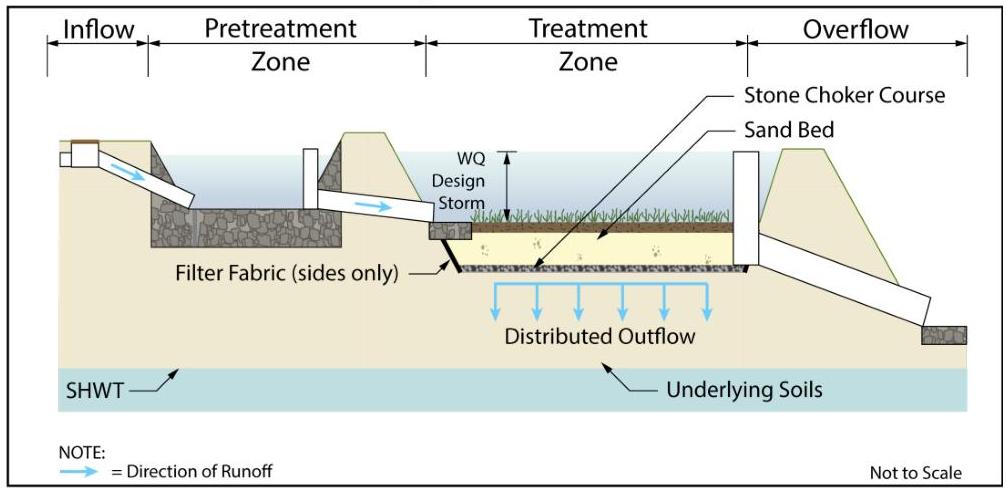
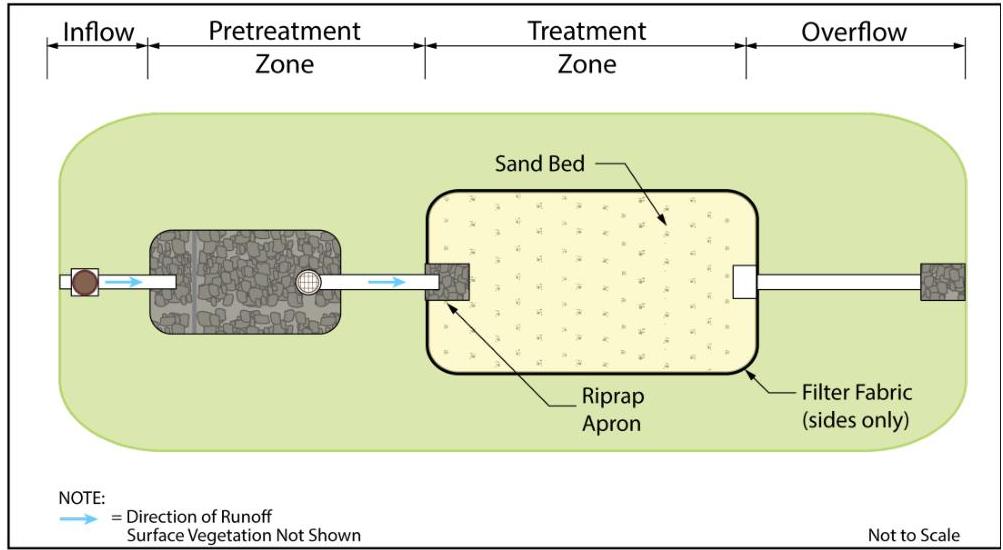
The following two illustrations show the basic components of a sand filter system designed to infiltrate into the subsoil and the various zones through which stormwater runoff travels.

[OCR image]
Profile View – Sand Filter Designed to Infiltrate into the Subsoil

[OCR image]
Plan View – Sand Filter Designed to Infiltrate into the Subsoil
PDF page 4, image 2
Mistral ID: img-6.jpeg. Extraction bundle(s): 2023_BMP_10_3_Sand_Filters. Original page | Image file
Surrounding OCR excerpt:
er system designed to infiltrate into the subsoil and the various zones through which stormwater runoff travels.

[OCR image]
Profile View – Sand Filter Designed to Infiltrate into the Subsoil

[OCR image]
Plan View – Sand Filter Designed to Infiltrate into the Subsoil
PDF page 9, image 1
Mistral ID: img-7.jpeg. Extraction bundle(s): 2023_BMP_10_3_Sand_Filters. Original page | Image file
Surrounding OCR excerpt:
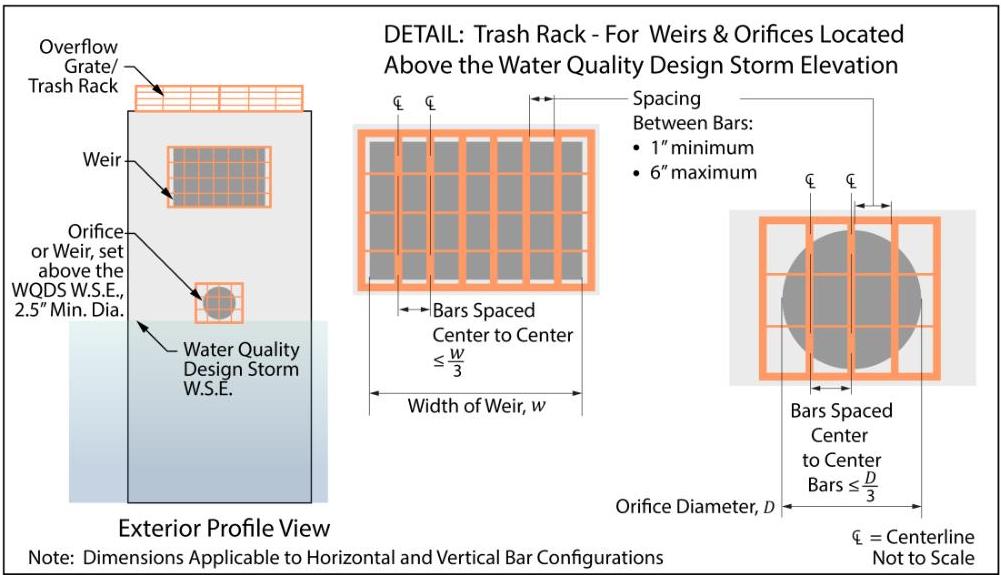
scharge, computed on the basis of the net area of opening through rack;
Constructed of rigid, durable and corrosion-resistant material; and
Designed to withstand a perpendicular live loading of 300 lbs./sf.

[OCR image]

- An overflow grate is designed to prevent obstruction of the overflow structure. If an outlet structure has an overflow grate, the grate must comply with the following requirements:

☐ The overflow grate must be secured to the outlet structure but removable for emergencies and maintenance;
☐ The overflow grate spacing must be no greater than 2 inches across the smallest dimension; and
☐ The overflow g
PDF page 10, image 1
Mistral ID: img-8.jpeg. Extraction bundle(s): 2023_BMP_10_3_Sand_Filters. Original page | Image file
Surrounding OCR excerpt:
[OCR image]

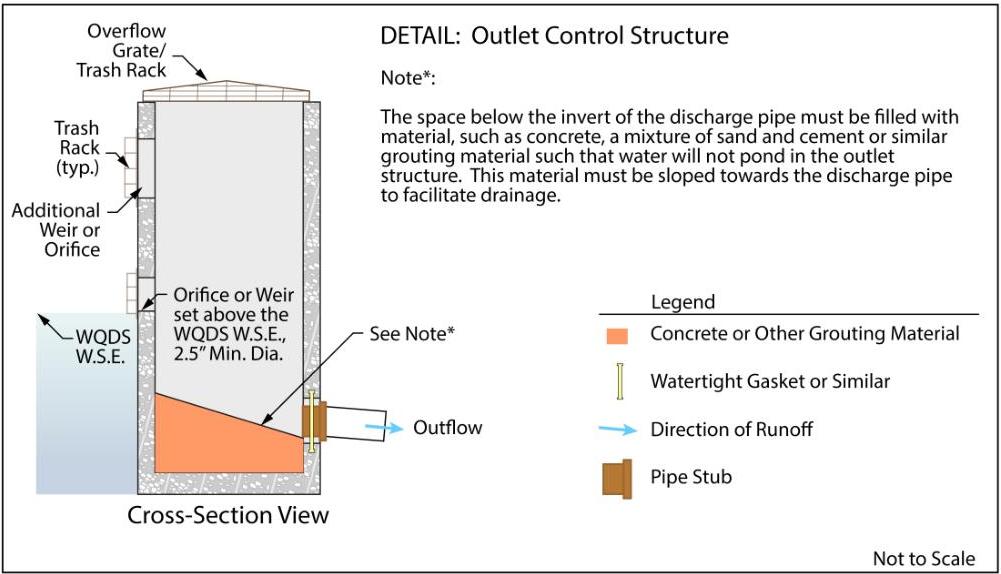
- The minimum diameter of any overflow orifice is 2.5 inches.
- Blind connections to down-gradient facilities are prohibited. Any connection to down-gradient stormwater management facilities must include access points such as inspections ports and manholes, for visual inspection and maintenance, as appropriate, to prevent blockage of flow and ensure operation as intended. All entrance points must adher
PDF page 12, image 1
Mistral ID: img-9.jpeg. Extraction bundle(s): 2023_BMP_10_3_Sand_Filters. Original page | Image file
Surrounding OCR excerpt:
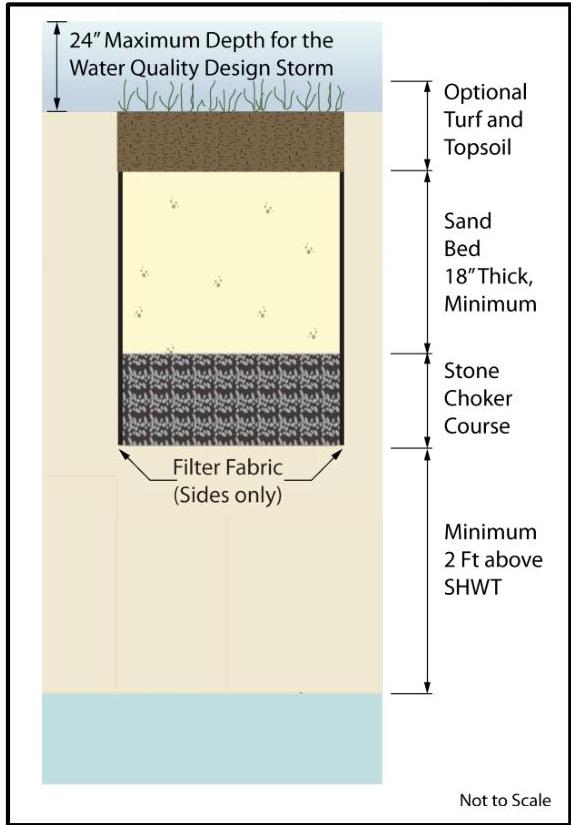
The following cross-section view provides another view of a sand filter designed to infiltrate into the subsoil.

[OCR image]
Cross Section View – Sand Filter Designed to Infiltrate

## Requirements for Extended Detention Option

A sand filter designed to infiltrate into the subsoil may be constructed as part of an on-line, combination system to provide extended detention for larger storms. Such a system could include a level-graded infiltration zone such as that defined by a smaller contour, oval or other discrete area within
PDF page 15, image 1
Mistral ID: img-10.jpeg. Extraction bundle(s): 2023_BMP_10_3_Sand_Filters. Original page | Image file
Surrounding OCR excerpt:
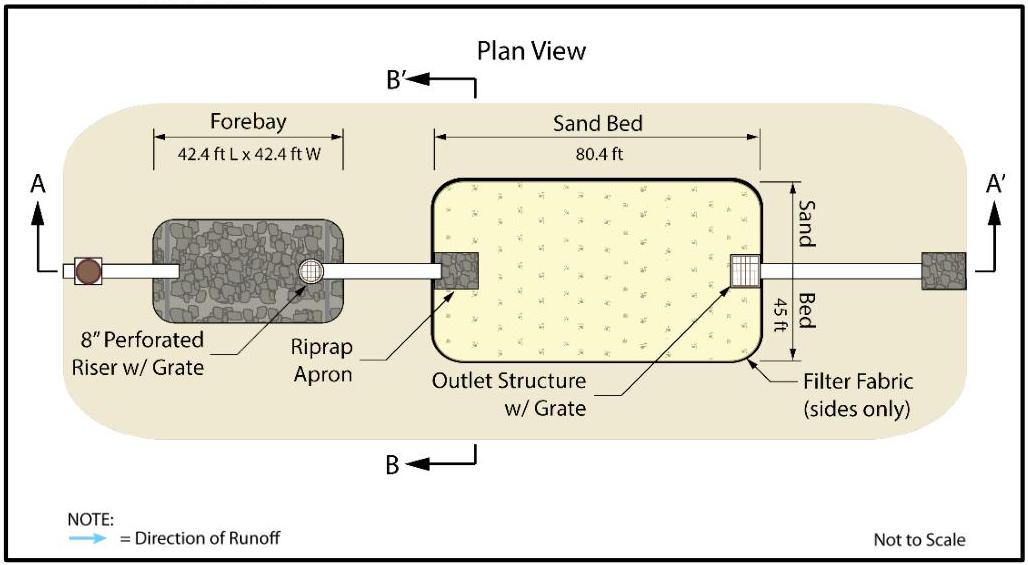
Example - Sand Filter System Designed to Infiltrate into the Subsoil Plan View

[OCR image]

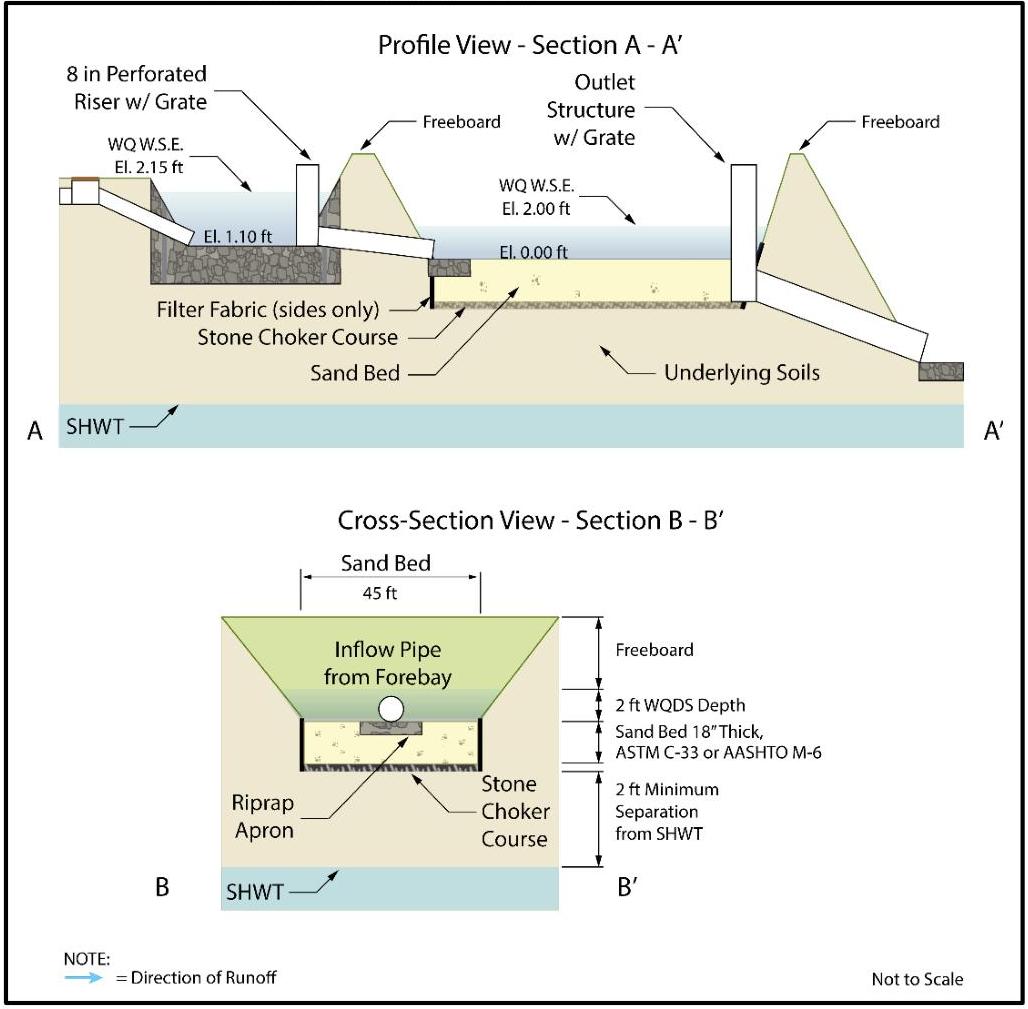
Example - Sand Filter System Designed to Infiltrate into the Subsoil Profile and Cross-Section Views

[OCR image]
PDF page 15, image 2
Mistral ID: img-11.jpeg. Extraction bundle(s): 2023_BMP_10_3_Sand_Filters. Original page | Image file
Surrounding OCR excerpt:
ple - Sand Filter System Designed to Infiltrate into the Subsoil Plan View

[OCR image]

Example - Sand Filter System Designed to Infiltrate into the Subsoil Profile and Cross-Section Views

[OCR image]