Extracted images: Grass Swales (Small-Scale GI)
Printed revision: January 2026.
Back to source | Original PDF | Image metadata
Original Mistral crops are preserved byte for byte. A crop can be a figure, table, equation, or other visual; no visual content is inferred as a numerical rule. Record and table associations use the same PDF page unless a direct image placeholder is identified. Nearby OCR excerpts are context, not verified captions.
PDF page 1, image 1
Mistral ID: img-0.jpeg. Extraction bundle(s): 2026_BMP_9_3_Grass_Swales. Original page | Image file
Tables on the same PDF page: Table 1
Surrounding OCR excerpt:
# 9.3 GRASS SWALES

[OCR image]

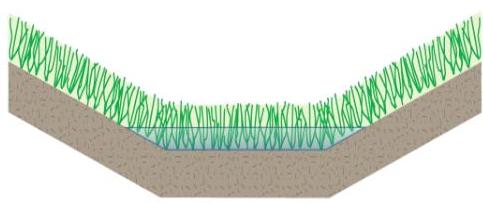
A grass swale is a stable, parabolic or trapezoidal channel that is lined with turf; it is used to improve water quality and convey stormwater runoff. Grass swales do not rely on the permeability of the underlying soil for pollutant removal; instead, pollutants are removed by settling and filtration through the grass. The maximum total suspended solids (TSS) removal rate is 50%.

|  N.J.A.C. 7:8 Stormw
PDF page 2, image 1
Mistral ID: img-1.jpeg. Extraction bundle(s): 2026_BMP_9_3_Grass_Swales. Original page | Image file

Surrounding OCR excerpt:
t is not applicable to grass swales.

Grass swales must have a maintenance plan and must be reflected in a deed notice recorded in the county clerk's office to prevent alteration or removal.

# Applications

[OCR image]

Pursuant to N.J.A.C. 7:8-5.2(a)(2), the minimum design and performance standards for groundwater recharge, stormwater runoff quality and stormwater runoff quantity at N.J.A.C. 7:8- 5.4, 5.5 and 5.6 shall be met by incorporating green infrastructure in accordance with N.J.A.C. 7:8-5.3.

[OCR image]

Grass swales may be designed to convey storm events larger than the Water Quality Design St
PDF page 2, image 2
Mistral ID: img-2.jpeg. Extraction bundle(s): 2026_BMP_9_3_Grass_Swales. Original page | Image file

Surrounding OCR excerpt:
s for groundwater recharge, stormwater runoff quality and stormwater runoff quantity at N.J.A.C. 7:8- 5.4, 5.5 and 5.6 shall be met by incorporating green infrastructure in accordance with N.J.A.C. 7:8-5.3.

[OCR image]

Grass swales may be designed to convey storm events larger than the Water Quality Design Storm; regardless of the design storm chosen, all grass swales must be designed for stability and capacity in accordance with the Standards for Soil Erosion and Sediment Control in New Jersey.

[OCR image]

To merit the approved TSS removal rate of up to a maximum of 50%, grass swales must be designed
PDF page 2, image 3
Mistral ID: img-3.jpeg. Extraction bundle(s): 2026_BMP_9_3_Grass_Swales. Original page | Image file

Surrounding OCR excerpt:
uality Design Storm; regardless of the design storm chosen, all grass swales must be designed for stability and capacity in accordance with the Standards for Soil Erosion and Sediment Control in New Jersey.

[OCR image]

To merit the approved TSS removal rate of up to a maximum of 50%, grass swales must be designed to treat the Water Quality Design Storm (WQDS) and in accordance with all of the design criteria below.
PDF page 3, image 1
Mistral ID: img-4.jpeg. Extraction bundle(s): 2026_BMP_9_3_Grass_Swales. Original page | Image file
Surrounding OCR excerpt:
N.J.A.C. 7:8-5.2(f):

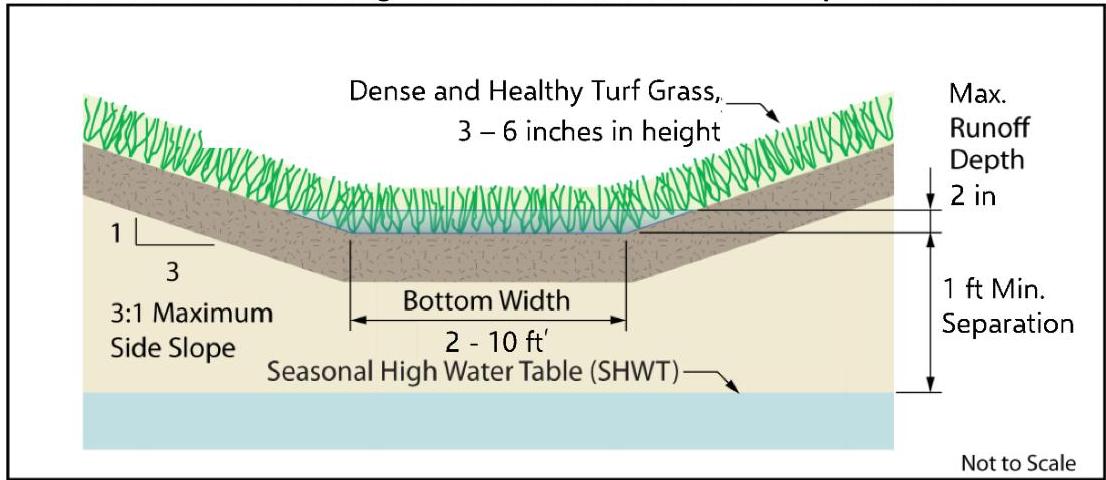
☐ At least 1 foot, when the swale is designed with a slope equal to or greater than 2 percent; or
☐ A minimum of 2 feet, when the swale is designed with a slope of less than 2 percent.

[OCR image]
PDF page 5, image 1
Mistral ID: img-5.jpeg. Extraction bundle(s): 2026_BMP_9_3_Grass_Swales. Original page | Image file
Surrounding OCR excerpt:
n meets all Cross Sectional Geometry Criteria
- ☐ Swale Design meets all Flow Characteristics Criteria
- ☐ Swale Design meets all Longitudinal Geometry Criteria
- ☐ Swale Design meets all Stability Criteria

[OCR image]
PDF page 6, image 1
Mistral ID: img-6.jpeg. Extraction bundle(s): 2026_BMP_9_3_Grass_Swales. Original page | Image file
Surrounding OCR excerpt:
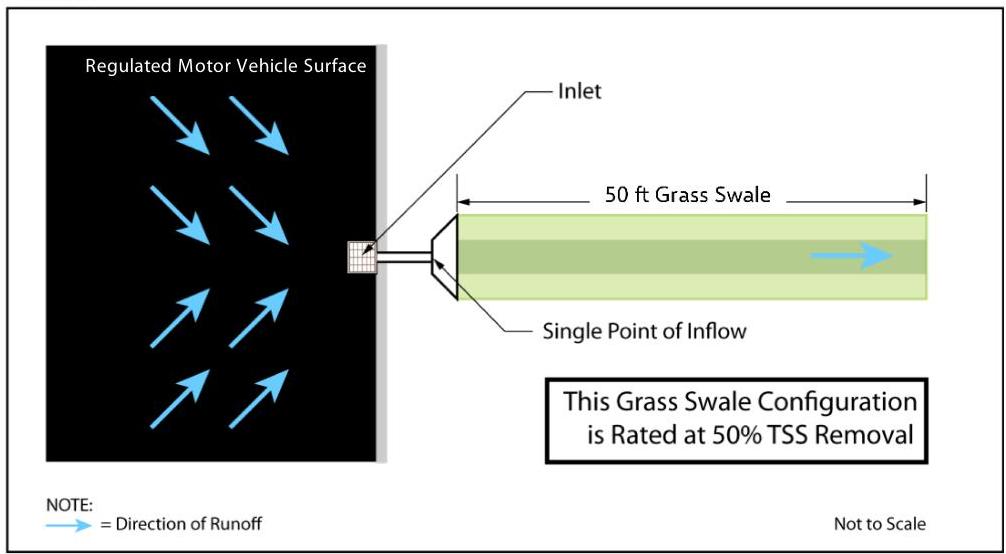
e area is collected prior to entering the swale, and assuming that all of the other design criteria for water quality are met, the entire inflow contributory drainage area receives the 50% TSS removal rate.

[OCR image]

Example 1

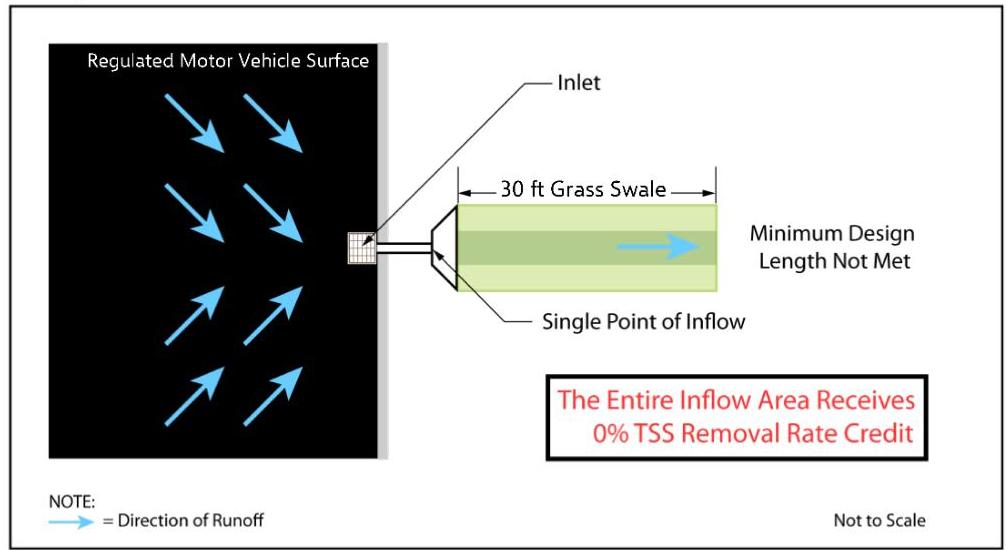
In Example 2, the swale length does not meet the minimum requirement of 50 feet; therefore, this Point Inflow Grass Swale achieves a TSS removal rate of 0%, as does the inflow contributory drainage area.

[OCR image]

Example 2
PDF page 6, image 2
Mistral ID: img-7.jpeg. Extraction bundle(s): 2026_BMP_9_3_Grass_Swales. Original page | Image file
Surrounding OCR excerpt:
1

In Example 2, the swale length does not meet the minimum requirement of 50 feet; therefore, this Point Inflow Grass Swale achieves a TSS removal rate of 0%, as does the inflow contributory drainage area.

[OCR image]

Example 2
PDF page 7, image 1
Mistral ID: img-8.jpeg. Extraction bundle(s): 2026_BMP_9_3_Grass_Swales. Original page | Image file
Surrounding OCR excerpt:
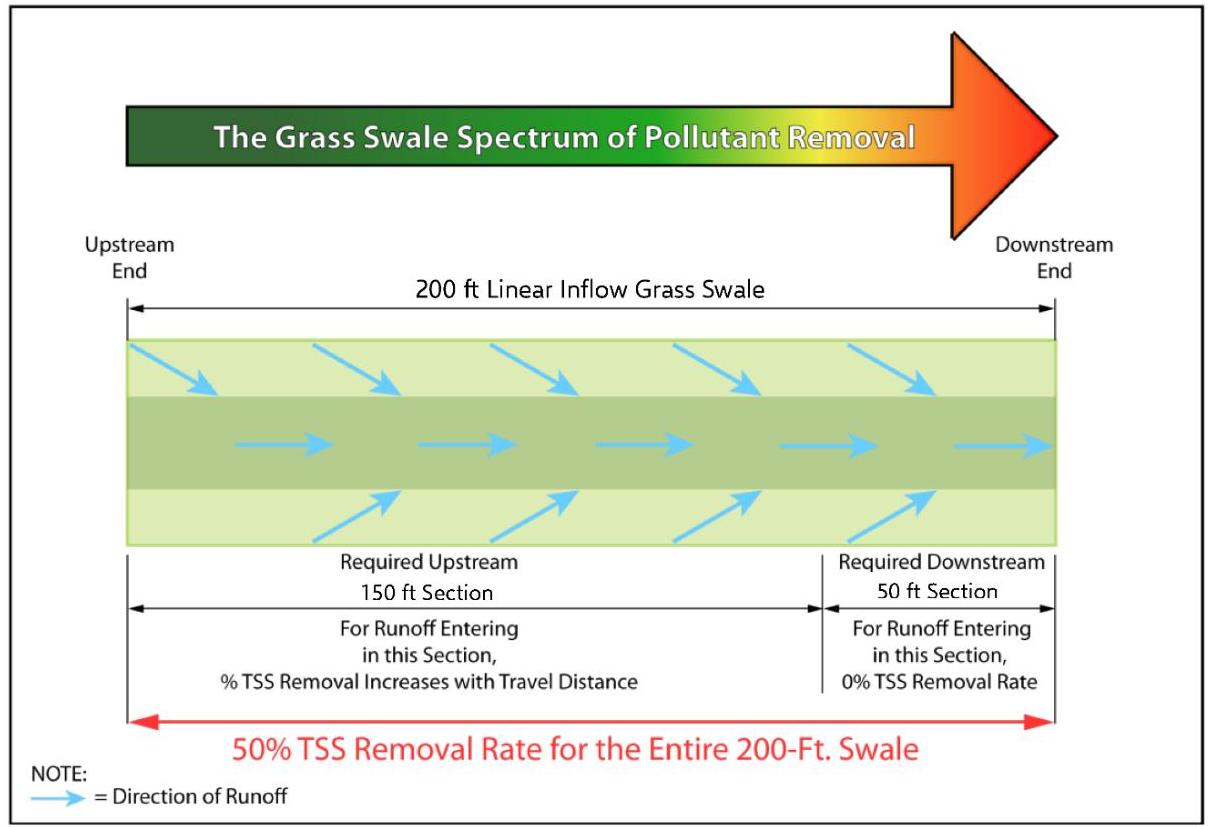
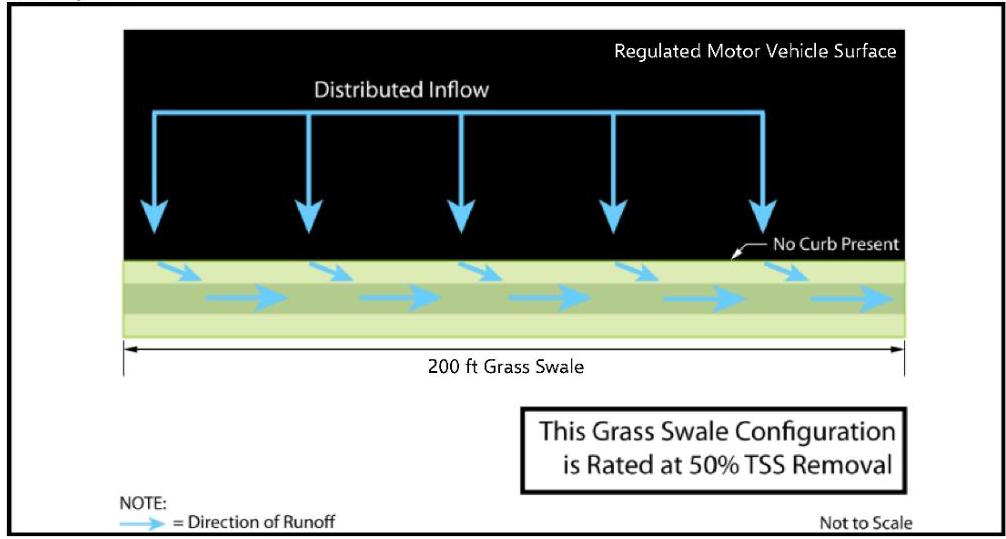
y meet all other criteria, because the runoff entering upstream receives enough treatment to compensate for the low level of treatment in the downstream section, as shown in Example 3 on the following page.

[OCR image]
PDF page 8, image 1
Mistral ID: img-9.jpeg. Extraction bundle(s): 2026_BMP_9_3_Grass_Swales. Original page | Image file
Surrounding OCR excerpt:
Example 3

[OCR image]

# Linear Inflow Grass Swales less than 200 Feet in Length

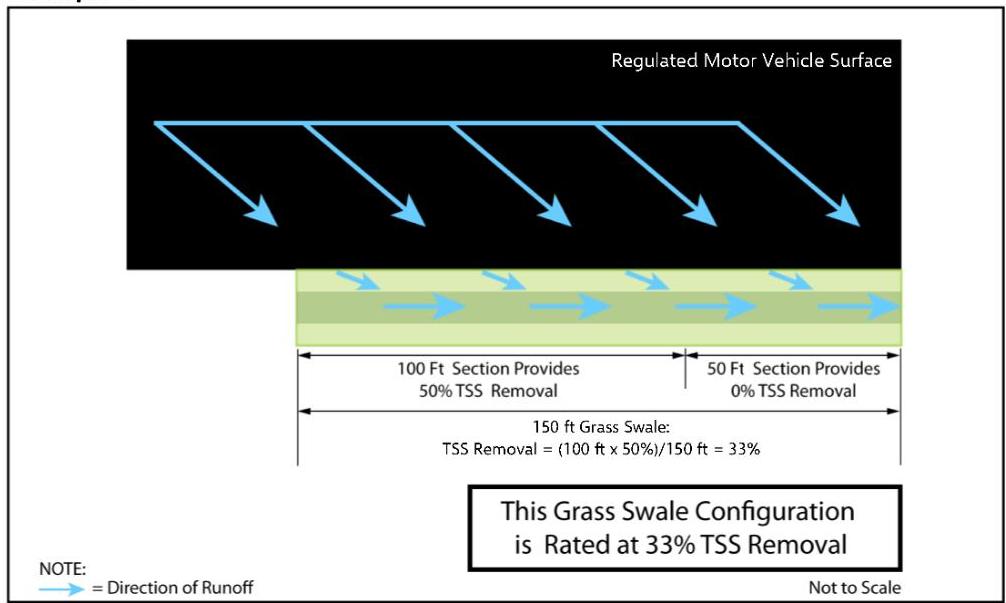
Example 4 shows a 150 foot Linear Inflow Grass Swale that collects runoff from a roadway. In this example, however, the TSS removal rate for the entire inflow contributory drainage area is less than 50% because the swale is less than 200 feet in length. As mentioned above, the minimum 200 foot length is necessary to offset the 0% TSS removal pr
PDF page 8, image 2
Mistral ID: img-10.jpeg. Extraction bundle(s): 2026_BMP_9_3_Grass_Swales. Original page | Image file
Surrounding OCR excerpt:
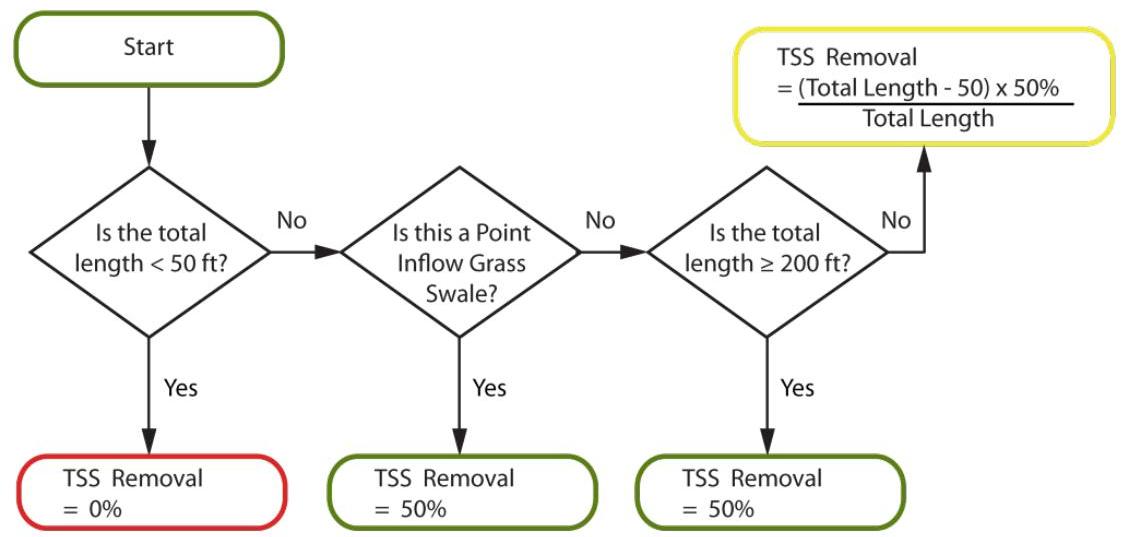
n the swale length is less than 200 feet, the two sections are evaluated using the formula from the flowchart depicted on Page 5, resulting in a weighted average for TSS removal, as shown below.

Example 4

[OCR image]
PDF page 9, image 1
Mistral ID: img-11.jpeg. Extraction bundle(s): 2026_BMP_9_3_Grass_Swales. Original page | Image file
Surrounding OCR excerpt:
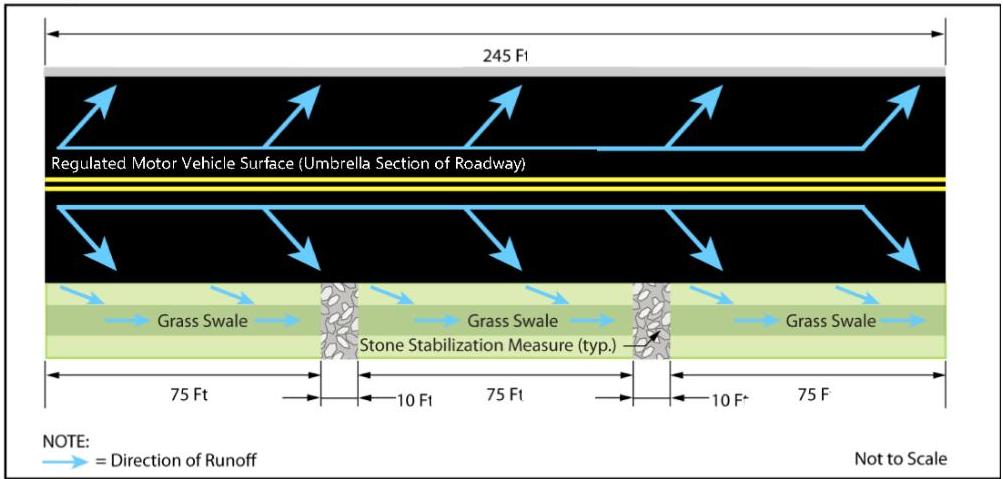
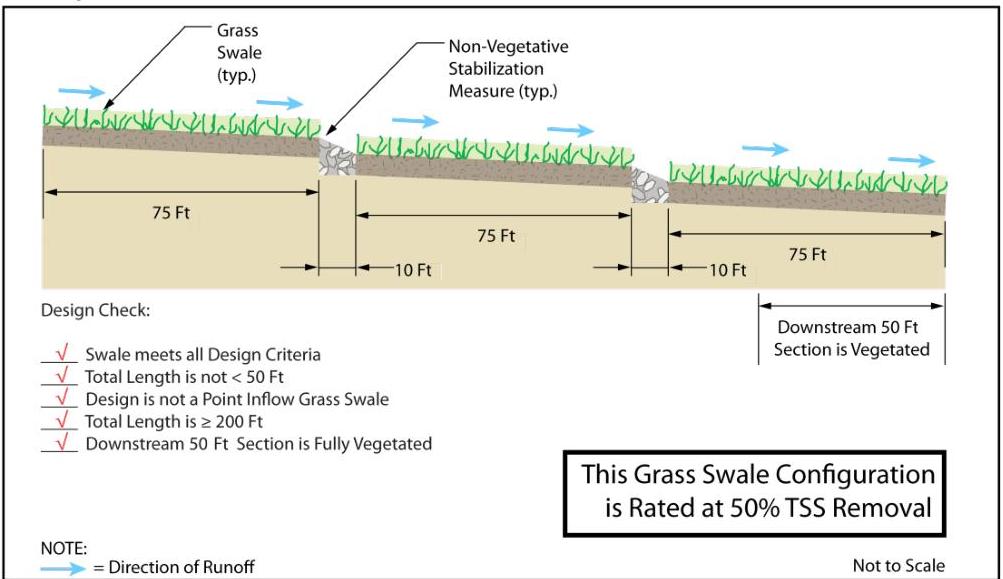
The length of the non-vegetative stabilization is excluded from the length calculation of the swale; therefore, the entire inflow contributory drainage area to this swale receives the 50% TSS removal rate.

[OCR image]

Example 5: Plan View

[OCR image]
PDF page 9, image 2
Mistral ID: img-12.jpeg. Extraction bundle(s): 2026_BMP_9_3_Grass_Swales. Original page | Image file
Surrounding OCR excerpt:
xcluded from the length calculation of the swale; therefore, the entire inflow contributory drainage area to this swale receives the 50% TSS removal rate.

[OCR image]

Example 5: Plan View

[OCR image]
PDF page 10, image 1
Mistral ID: img-13.jpeg. Extraction bundle(s): 2026_BMP_9_3_Grass_Swales. Original page | Image file
Surrounding OCR excerpt:
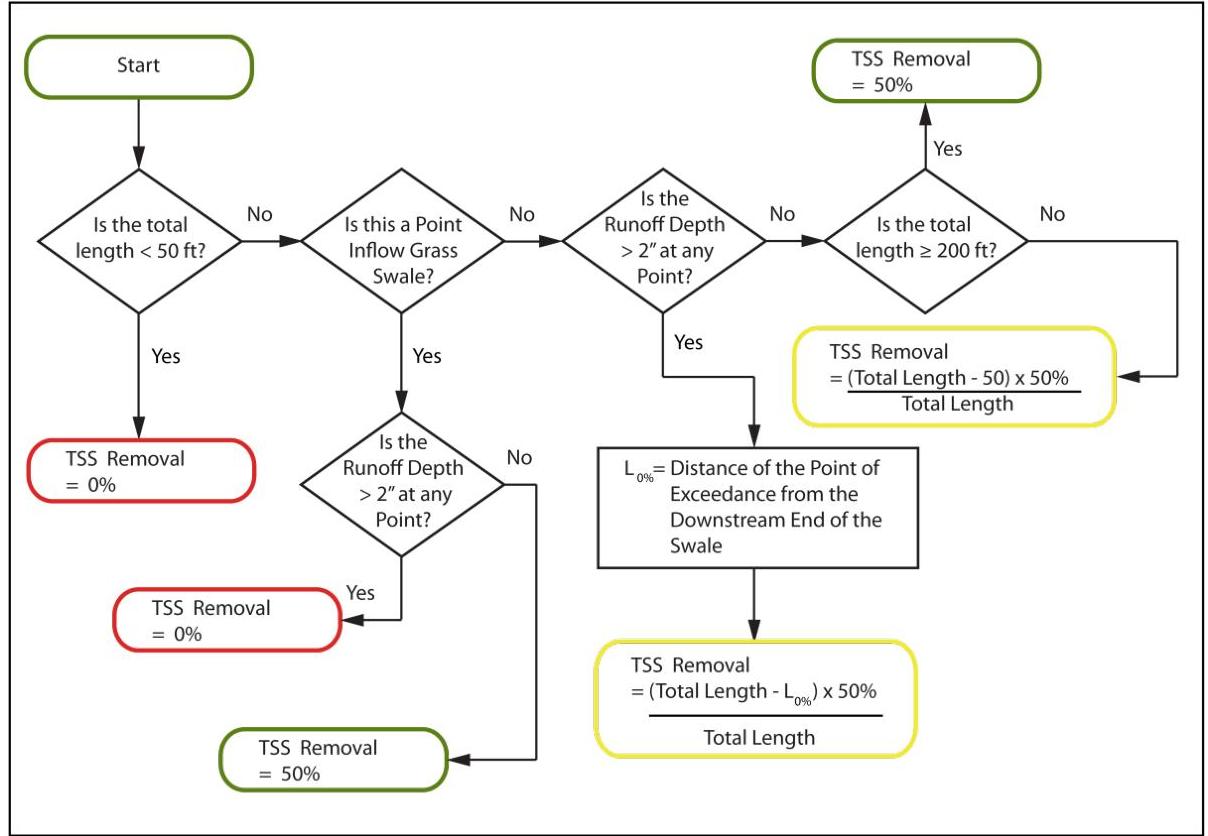
s on the length of the swale and the distance of the point of exceedance from the downstream end of the swale.

The flowchart below includes a method for calculating the TSS removal rate for this scenario.

[OCR image]
PDF page 11, image 1
Mistral ID: img-14.jpeg. Extraction bundle(s): 2026_BMP_9_3_Grass_Swales. Original page | Image file
Surrounding OCR excerpt:
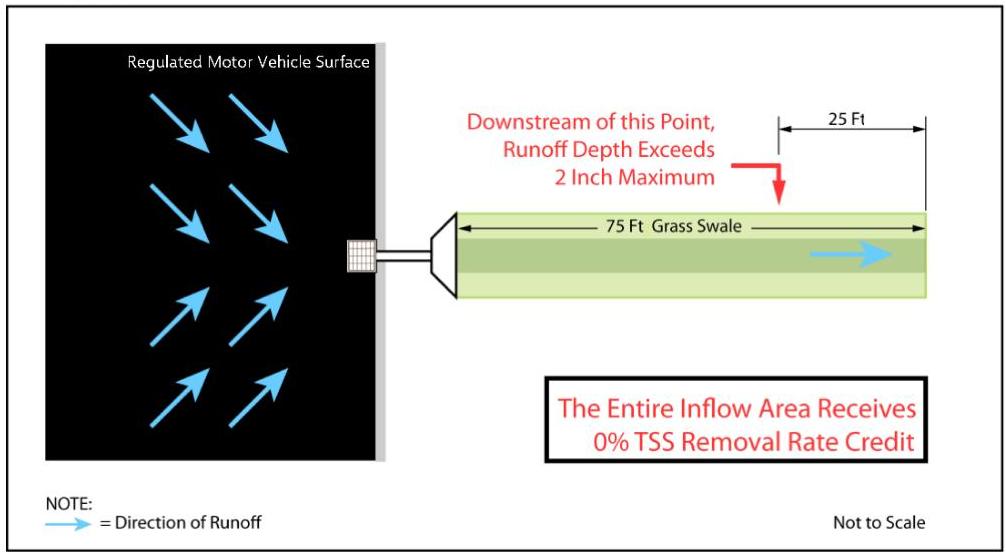
off depth that exceeds the maximum 2 inches. Despite its compliance with all other design criteria, the inflow contributory drainage area treated by this swale receives a 0% TSS removal rate.

## Example 6

[OCR image]

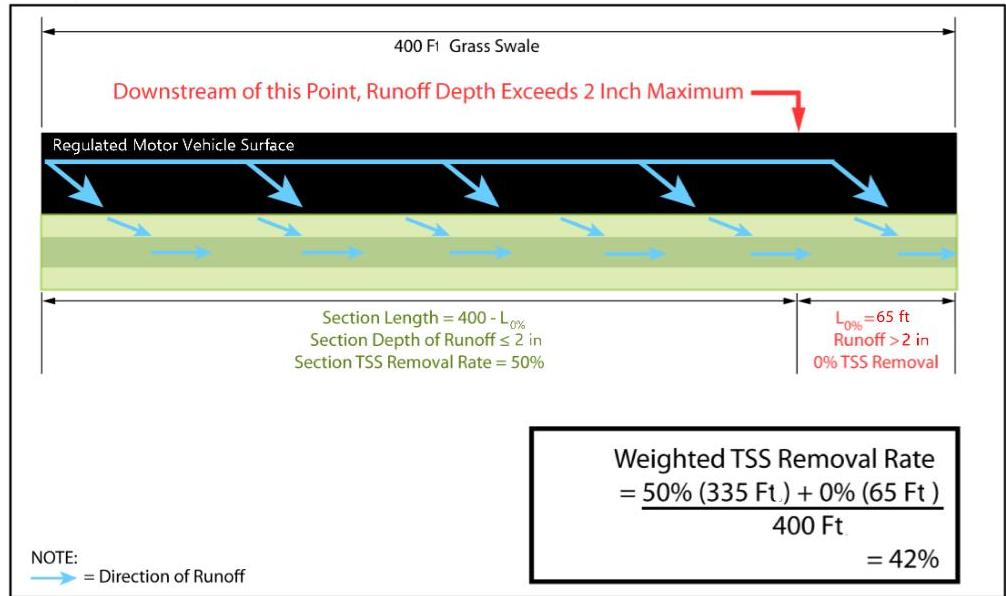
Example 7 illustrates the TSS removal rate calculation for a 400 foot Linear Inflow Grass Swale with a runoff depth exceedance beginning at a distance of 65 feet from the downstream end of the swale.

## Example 7

[OCR image]

Note: Although the portion of the swale treating the last 65 feet of the roadway in Example 7 does not receive the 50% TSS removal rate, the grass swale may be
PDF page 11, image 2
Mistral ID: img-15.jpeg. Extraction bundle(s): 2026_BMP_9_3_Grass_Swales. Original page | Image file
Surrounding OCR excerpt:
7 illustrates the TSS removal rate calculation for a 400 foot Linear Inflow Grass Swale with a runoff depth exceedance beginning at a distance of 65 feet from the downstream end of the swale.

## Example 7

[OCR image]

Note: Although the portion of the swale treating the last 65 feet of the roadway in Example 7 does not receive the 50% TSS removal rate, the grass swale may be used as a vegetated conveyance to transport stormwater runoff to a down-gradient stormwater BMP in the treatment train. The reduced TSS removal rate calculated above would be used in the equation found in N.J.A.C. 7:8-5.5(e) to determine the TS